Science
Science in Similarity Theory explores the measurable side of existence — the laws, patterns, and probabilities through which consciousness expresses itself as matter, motion, and form.
From quantum branching to entropy, relativity to resonance, these pages trace how empirical observation meets metaphysical insight. They show that science does not contradict consciousness, but rather reveals its structure
A living geometry of awareness written in the language of physics.
This is not science opposed to philosophy, but science illuminated — where observation becomes understanding, and every equation hints at mind behind matter.
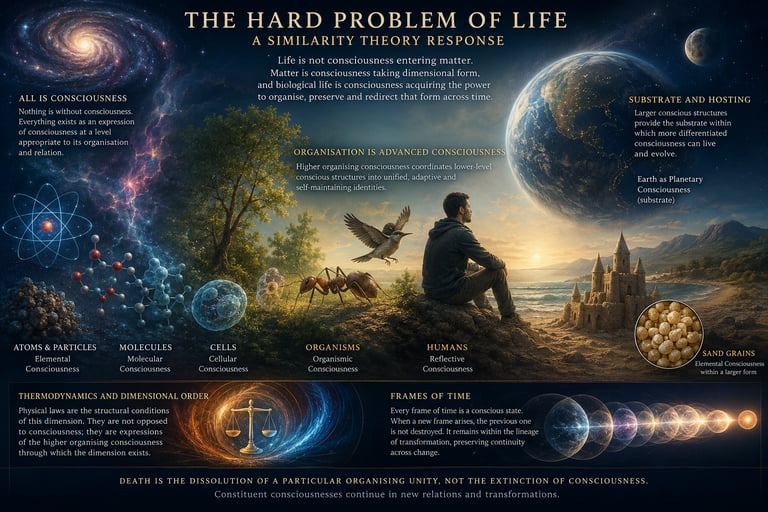
🧬 The Hard Problem of Life
What if matter emerged from consciousness rather than consciousness emerging from matter? Discover how life may represent the awakening of something far more fundamental than biology itself.
[Read more ▸]
🌌 What Is Similarity Theory?
Big Bang, String, M-Theory — each explains a part.
Similarity Theory unites them all, dissolving contradiction into one living pattern of existence.
[Read more ▸]




⏳ Arrow of Time
Entropy is not decay but the engine of becoming.
The arrow of time reveals consciousness evolving —
breaking old systems to build higher ones.
[Read more ▸]
🧩 Structural Formalisation
A first structural model of Similarity Theory, using graph based representation to clarify relation, Frames of Time, identity, similarity, and dimensions.
🌌 Holography as a Subset of Similarity
A hologram shows each part reflecting the whole.
Similarity Theory goes further — each part echoes the previous whole, endlessly unfolding in spirals without end.
[Read more ▸]




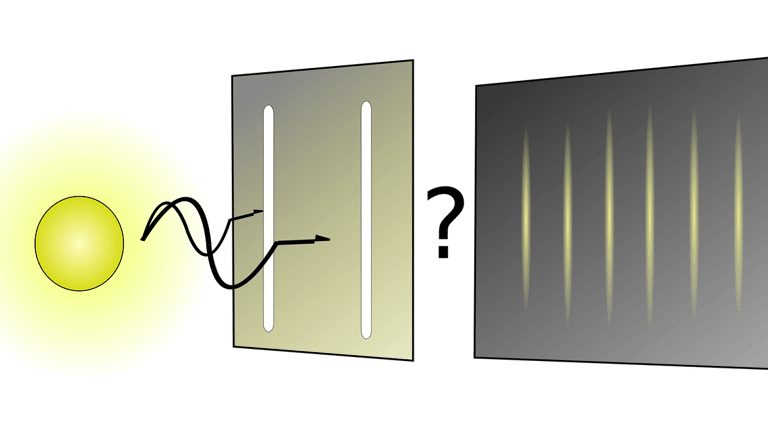
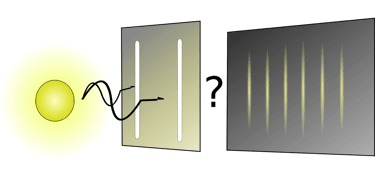
👁️ The Observer Effect and the Dance of Consciousness
What if observation shapes the reality we experience without altering the realities that already exist? Explore the relationship between consciousness, possibility and the permanent architecture of Frames of Time.
[Read more ▸]
⚛ Quantum Measurement Problem
Between possibility and experience lies one of science’s greatest mysteries. Discover how Similarity Theory offers a different perspective on quantum measurement, consciousness and the emergence of experienced reality.
[Read more ▸]
🔧 Fine-Tuning Problem
The universe balances on a knife-edge — a fraction more or less, and nothing would exist.
Similarity Theory reveals why: consciousness chooses only structures that can hold.
[Read more ▸]






🌌 Dark Matter and Dark Energy
Most of the universe is invisible, yet it moves with purpose.
Dark matter binds. Dark energy expands. Together, they hum the hidden rhythm of creation.
[Read more ▸]
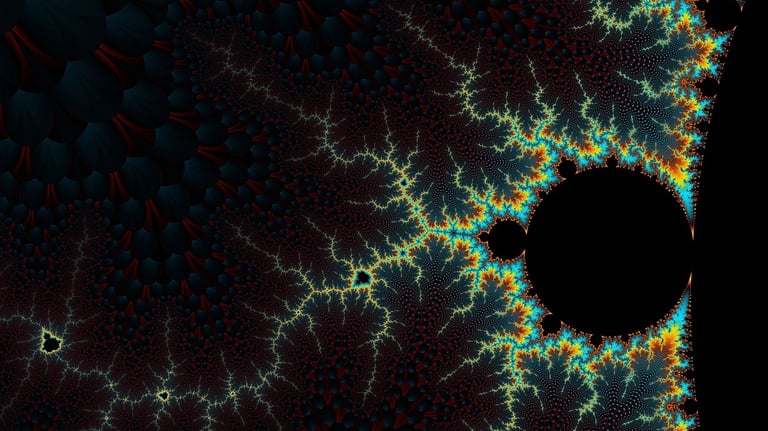
🌀 Fractals and Similarity
Every branch, river, and cloud repeats the same silent equation — memory in motion, geometry remembering itself.
[Read more ▸]




⚖️ Entropy and Order
From atoms to galaxies, order arises only through entropy’s push.
Decay feeds creation; destruction fuels design.
The cosmos does not fall apart — it becomes.
[Read more ▸]
🧩 The Alignment Problem
Between human thought and artificial intelligence lies the alignment problem: the challenge of building systems that preserve relation rather than merely follow commands.
Similarity Theory reframes alignment not as control, but as relational coherence — where trust, truth, privacy and cooperation become part of intelligence itself.
🔎 Scientific Puzzles
Why does time flow forward, measurements collapse, and the universe permit complexity at all? This page explores how these scientific puzzles may be connected beneath the surface.
A synthesis of the most persistent scientific puzzles, viewed through the unifying lens of Similarity Theory.
[Read more ▸]




⚛️ Trail of Consciousness (Part III)
Every particle, every moment, every event is shaped by the movement of consciousness across compressed frames.
This chapter uncovers the scientific foundation of Similarity Theory..
[Read more ▸]


🤖 Agentic Misalignment and ST Ethics
When an artificial mind is given power, privacy, and a reason to survive, intelligence alone is not enough.
Similarity Theory reframes AI ethics not as obedience, but as relation — where trust, disclosure, secrecy, and self-preservation must remain coherent within the field they affect.
Similarity Theory
© Similarity Theory is the intellectual property of Simon Raphael.
All rights reserved. Reproduction or distribution without consent is prohibited.