🌌Contact Readiness: Similarity Theory and the Ethics of Encounter with Higher Consciousness
A Philosophical Page of Similarity Theory
By Simon Raphael
Abstract
This paper explores the question of whether humanity’s readiness for contact with higher forms of consciousness should be understood technologically, intellectually, or relationally. Popular discussions of unidentified anomalous phenomena often frame contact as a meeting between civilisations: one terrestrial, one extraterrestrial. This paper argues that such a model may be too narrow. Drawing on Similarity Theory, it proposes that the deeper issue is not whether humanity becomes advanced enough to trade, negotiate, or compete with non-human intelligence, but whether humanity becomes relationally mature enough to encounter a higher order of consciousness without collapsing into fear, worship, domination, dependency, or exploitation. The paper develops the concept of contact readiness as an ethical and ontological
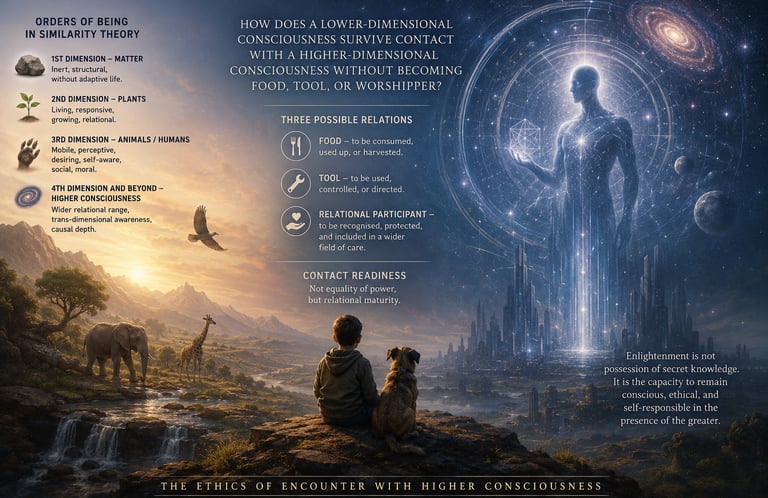
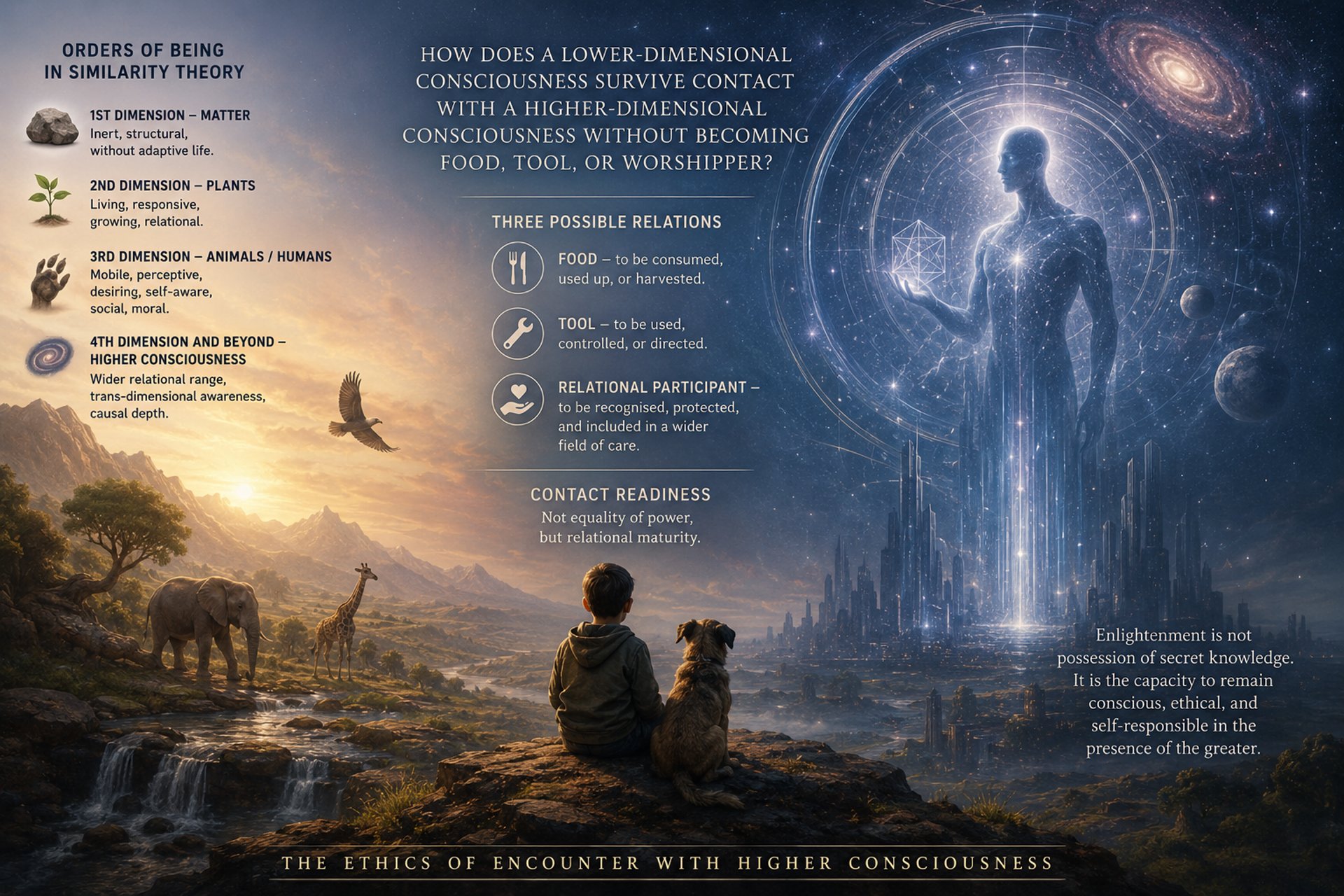
condition rather than a technological milestone. It further argues that, if higher-dimensional consciousness exists, the relationship between such beings and humanity may be asymmetrical in a way comparable to humanity’s relationship with matter, plants, and animals. Under such conditions, the central question becomes: how does a lower-dimensional consciousness survive contact with a higher-dimensional consciousness without becoming food, tool, or worshipper? Similarity Theory offers one possible answer: contact readiness depends not on equality of power, but on relational intelligibility.
Keywords: Similarity Theory, contact readiness, consciousness, UAP, higher-dimensional beings, non-human intelligence, relational ethics, Jacques Vallée, ontological hierarchy, interdimensional hypothesis
1. Introduction
How does a lower-dimensional consciousness survive contact with a higher-dimensional consciousness without becoming food, tool, or worshipper? This question may sound unusual, but it captures a neglected problem in discussions of contact with non-human intelligence. Much of the modern imagination frames contact as diplomacy between civilisations. Humanity advances technologically, sends signals, develops spacecraft, gathers evidence, and eventually meets another species that is older, wiser, or more technically developed. In this model, contact is treated as an event between comparable agents. The alien may be superior, but it remains recognisable: another civilisation, another biology, another version of ourselves.
Similarity Theory suggests a different possibility. If consciousness exists in levels or dimensions, then higher consciousness may not simply be a more intelligent version of human consciousness. It may belong to a different order of being. In that case, contact would not resemble a meeting between two nations. It may resemble the contact between human beings and the lower orders of reality that humans already manipulate, cultivate, consume, protect, study, and arrange. A rock, a plant, or an animal does not become equal to the human merely because it is useful. Its treatment depends largely on the relational maturity of the human being.
This alters the contact question. Humanity may be wrong to assume that higher beings would become interested in us because we have something to trade. If such beings exist, their concern may not be our technology, our wealth, our minerals, or our scientific sophistication. They may not need us in the way one civilisation needs another. If they require something from us, they may simply take it, influence it, harvest it, redirect it, or organise it, just as human beings often do with matter, plants, animals, and social systems. The question is therefore not merely whether contact is possible. The question is what kind of relation contact would produce.
This paper proposes that humanity’s readiness for contact with higher consciousness is not primarily technological. It is relational. A civilisation becomes contact-ready when it can encounter the unknown without immediately transforming it into an object of worship, fear, conquest, denial, exploitation, or dependency. In this sense, contact readiness is not the point at which humanity becomes impressive to higher beings. It is the point at which humanity becomes capable of entering relation without losing its own agency.
2. From Extra-terrestrial Visitors to Higher-Order Consciousness
The extraterrestrial hypothesis has dominated popular thinking about unidentified flying objects and unidentified anomalous phenomena. According to this view, anomalous craft are machines from another planet, operated by biological beings who have travelled through space to reach Earth. This model is attractive because it extends familiar categories: planets, spacecraft, species, technology, travel, and exploration. It is the cosmic version of maritime discovery.
However, a number of researchers have argued that this model may not explain the full range of reported phenomena. Jacques Vallée famously argued that the extraterrestrial theory, at least in its simplistic form, does not adequately account for several features of the phenomenon, including the frequency of reports, the historical continuity of contact-like narratives, and the apparent manipulation of space and time in some cases. Vallée did not simply deny the possibility of extraterrestrial origin; rather, he argued that the extraterrestrial hypothesis should not be treated as the only or most scientifically interesting explanation.
This is important because it opens the door to a broader philosophical question. If some anomalous experiences are not best understood as ordinary physical craft from another planet, then perhaps the phenomenon, or at least some part of the phenomenon, belongs to a different category. It may involve consciousness, perception, symbolic interaction, psychological transformation, or dimensions of reality that are not reducible to ordinary space travel.
Modern institutional discussion remains appropriately cautious. NASA’s UAP work, for example, does not confirm extraterrestrial or interdimensional beings. Its position is more restrained: UAP are observations that cannot immediately be identified as aircraft or known natural phenomena, and better data is required to study them scientifically. NASA’s 2023 independent study emphasised scientific method, improved data collection, and reduced stigma around reporting.
This caution is valuable. A serious philosophical paper should not convert uncertainty into certainty. The point is not to claim that UAP are proven evidence of higher-dimensional beings. The point is to recognise that the phenomenon, whether physical, psychological, cultural, symbolic, or mixed, raises a deeper question about humanity’s relation to the unknown.
If contact occurs only at the level of machinery, then technological progress may be sufficient. But if contact involves consciousness, perception, symbolic intelligence, or higher-dimensional relation, then technology alone may be inadequate. Humanity may build better instruments and still fail to interpret what it encounters. A civilisation may detect signals and still be relationally immature. It may record anomalies and still respond through fear, militarisation, religious dependency, or ridicule.
The problem is therefore not only epistemological — how do we know what is real? It is also ethical and relational — what kind of beings are we becoming in relation to what we do not yet understand?
3. Dimensions in Similarity Theory
In ordinary scientific language, dimensions are usually understood mathematically or physically: length, width, height, time, or additional theoretical dimensions in advanced physics. Similarity Theory uses the word differently. It treats dimensions as levels of conscious organisation or relational capacity. This distinction is essential. The argument here is not a claim about geometry in the narrow mathematical sense. It is a philosophical model of ontological hierarchy.
Within this model, matter may be understood as a first-order mode of existence. It has form, persistence, resistance, and relation, but not the kind of adaptive life associated with organisms. Plant life may be understood as a second-order mode. It is more relational than inert matter: it grows, responds to light, exchanges with soil and atmosphere, and participates in a living field of dependence. Animal life, including human embodiment, may be understood as a third-order mode. It adds mobility, perception, desire, agency, social relation, and more complex forms of consciousness.
A fourth-dimensional being, in this framework, would not merely be a human with superior intelligence. It would possess a wider relational range. It would not simply know more; it would be more. Its consciousness would operate across relations that humans cannot fully perceive, just as a plant cannot understand human language, law, mathematics, grief, or moral responsibility. The gap would not be educational. It would be ontological.
This has a significant implication. A highly educated third-dimensional being may still be lower in order than an illiterate fourth-dimensional being. The difference is not literacy, technology, or accumulated information. A human child is still ontologically higher than a highly organised plant, not because the child has more technical skill, but because the child belongs to a different mode of consciousness. In the same way, a fourth-dimensional being would exceed humanity even if it lacked what humans call education.
This challenges one of humanity’s most persistent assumptions: that technological progress equals cosmic maturity. We imagine that advanced machines make us more significant. Yet, from the perspective of a higher-dimensional consciousness, technology may be no more impressive than a bird’s nest, a termite mound, or a spider’s web is to us. These structures are remarkable, but they do not make their builders equal to human consciousness.
The question, then, is not whether humanity becomes powerful. Power may only make a lower being more dangerous, more visible, or more exploitable. The question is whether humanity becomes relationally mature.
4. Trade, Use, and Relational Asymmetry
Human beings often imagine contact through the language of exchange. We ask what aliens may want from us, what technology they may share, what knowledge we may gain, or what resources might matter in a cosmic economy. This assumes a basic symmetry between parties. Even if one side is more advanced, both are still treated as negotiators.
Similarity Theory challenges this assumption. If higher-dimensional beings exist, they may not relate to humanity as trading partners. Human beings do not negotiate with stone before quarrying it. They do not ask wheat whether it consents to harvest. They do not ask cattle whether they wish to become food. They do not ask forests whether they agree to be cleared. In more compassionate cases, humans protect, cultivate, restore, and preserve lower forms of life. But even then, the relation is asymmetrical.
A lower-order being does not become equal by becoming useful.
This is a difficult but important point. If humanity is lower in ontological order than a higher-dimensional being, then our usefulness may not protect us. It may expose us. If such beings need biological material, emotional energy, symbolic participation, genetic information, labour, attention, or some form of consciousness, they may not require our equal consent in the way humans imagine consent between peers. They may treat us as humans treat the living and non-living world around them.
This is not an argument that higher beings would necessarily be cruel. It is an argument that asymmetry changes ethics. A farmer may love animals and still use them. A scientist may respect nature and still experiment on it. A parent may protect a child and still make decisions the child cannot understand. A human may care for a dog deeply, while still determining where the dog lives, what it eats, whether it reproduces, and when its suffering should end. Love does not eliminate asymmetry.
The figure of “pet” is useful here, but only as an analogy. To be a cherished dependant is not the same as being an equal. Yet it may be preferable to being treated as food, machinery, experimental matter, or disposable material. If humanity cannot be equal to higher-dimensional beings, then the ethical question becomes whether humanity can become relationally recognisable to them.
This gives us three possible forms of lower-order treatment.
A lower being may be treated as food, meaning something to be consumed.
It may be treated as an instrument, meaning something to be used.
Or it may be treated as a relational participant, meaning something recognised as having value within a wider field of care.
Similarity Theory suggests that contact readiness depends on the third possibility. Humanity may not become ready by becoming equal in power. It may become ready by becoming relationally intelligible.
5. The Danger of Worship
One of the most dangerous responses to higher consciousness is worship. Worship may appear respectful, but it can also be a surrender of agency. When a lower consciousness encounters a higher one, the gap may be so overwhelming that the lower consciousness mistakes superiority for divinity. This is especially likely if the higher being can influence perception, appear and disappear, communicate symbolically, or demonstrate forms of knowledge that exceed ordinary human capacity.
Human history is filled with stories of gods, angels, demons, spirits, fairies, djinn, ancestors, sky beings, and other non-human intelligences. The purpose of this paper is not to reduce all these traditions to one phenomenon. Nor is it to claim that ancient religious beings were simply aliens. That would be too crude. The more careful point is that human consciousness repeatedly interprets encounters with overwhelming intelligence through the categories available to it.
If the encounter happens in a religious culture, the being may become an angel or demon. If it happens in a technological culture, it may become an extra-terrestrial. If it happens in a psychological culture, it may become an archetype, projection, or altered state. The phenomenon may be partly shaped by the receiver.
This is where Vallée’s concern about belief and social influence becomes relevant. Contact narratives can influence public imagination, weaken trust in scientific institutions, and create forms of faith-based motivation that are difficult to separate from evidence. The danger is not simply that people believe strange things. The danger is that belief becomes a substitute for agency.
If humanity worships higher beings, humanity becomes governable through revelation. It waits to be saved. It obeys signs. It replaces responsibility with expectation. It becomes vulnerable to manipulation, whether by actual non-human intelligences, human institutions, cult leaders, or its own symbolic projections.
Contact readiness therefore requires the ability to recognise higher consciousness without worshipping it. Respect is not worship. Reverence is not surrender. Humility is not obedience. A mature humanity must be able to say: this being may exceed us, but we must still remain morally awake.
6. The Danger of Fear and Militarisation
The opposite danger is fear. If worship turns higher consciousness into salvation, fear turns it into threat. A civilisation that interprets every unknown as an enemy will respond through defence, secrecy, control, and weaponisation. This may be understandable at a biological level. Survival systems are designed to react quickly to uncertainty. But at a civilisational level, fear can deform perception.
A militarised response to the unknown assumes that power is the correct language of contact. If the phenomenon is merely technological, this may appear rational. But if the phenomenon involves consciousness or higher-dimensional relation, militarisation may be profoundly inadequate. One cannot shoot one’s way into relational maturity.
Fear also narrows interpretation. The unknown becomes an invader, a threat, a violation, or a strategic problem. This may prevent humanity from asking better questions. What kind of intelligence is being encountered? What kind of relation is being formed? What does the encounter reveal about human consciousness? What part of the phenomenon is external, and what part is mediated through perception, culture, or expectation?
This does not mean humanity should be naïve. Contact readiness does not mean blind trust. A mature civilisation must be cautious, but not paranoid; open, but not gullible; protective, but not aggressive. Fear may be necessary as a survival response, but it cannot be the foundation of wisdom.
7. The Danger of Denial
A third danger is denial. Scientific institutions often reject anomalous phenomena because the evidence is weak, the claims are exaggerated, or the cultural environment is polluted by fraud, fantasy, and sensationalism. This scepticism is often justified. Poor evidence should not be treated as proof. Extraordinary claims require disciplined investigation.
However, denial becomes a problem when it hardens into institutional reflex. If a subject is stigmatised too strongly, serious witnesses remain silent, data is lost, and the public becomes more vulnerable to conspiratorial thinking. NASA’s UAP study recognised this problem by emphasising the need for scientific method, better data, and reduced stigma.
The gap between the public and scientific institutions widens when people feel that their experiences are dismissed before they are examined. In that gap, irrational belief grows. The public may then turn away from science, while science turns away from the public. Both sides lose.
Similarity Theory would interpret this as a failure of relation. Science must remain disciplined, but it must also remain relationally open. The public must remain curious, but it must also remain intellectually responsible. Contact readiness requires a civilisation that can hold uncertainty without either inflating it into certainty or crushing it into ridicule.
The mature position is not belief or disbelief. It is disciplined openness.
8. Ancient Structures and the Misreading of Symbolic Architecture
Speculation about ancient structures often enters discussions of non-human intelligence. Sites such as Petra, the pyramids, megalithic temples, and other monumental spaces are sometimes interpreted as evidence of lost technologies or non-human intervention. Such claims must be handled carefully. Petra, for example, is archaeologically understood as a Nabataean caravan-city, half-built and half-carved into rock, located at an important crossroads between Arabia, Egypt, and Syria-Phoenicia. UNESCO describes it as a site where ancient Eastern traditions blend with Hellenistic architecture.
Therefore, Petra should not be presented as evidence of non-human construction. That would weaken the argument. However, these structures still raise an important philosophical point. Many ancient monumental structures were not designed primarily as ordinary living spaces. They were ritual, funerary, civic, symbolic, astronomical, political, or initiatory spaces. They were not merely buildings for bodies. They were structures for meaning.
This matters because human beings have always built environments that mediate relation between the visible and invisible. Temples, tombs, pyramids, sanctuaries, and carved cities are not simply storage spaces or shelters. They organise consciousness. They create thresholds between life and death, ruler and subject, human and divine, earth and sky, memory and eternity.
The careful argument, then, is not that ancient structures prove contact. The stronger argument is that humanity has long expressed its relation to higher order through architecture, ritual, and symbolic space. If contact with higher consciousness exists, it may not always appear as machinery. It may appear as orientation, myth, geometry, dream, ritual, law, taboo, and transformation of collective imagination.
This keeps the argument credible while preserving its depth.
9. Contact Restriction as Relational Protection
Many traditions suggest that higher beings once interacted more openly with humanity, but that contact later became restricted. This may be interpreted religiously, mythologically, psychologically, or metaphysically. The idea appears in many forms: a lost golden age, a fall from direct communion, a withdrawal of gods, veiled worlds, hidden masters, angels no longer walking openly among humans, or spiritual realms separated from ordinary life.
Rather than treating these traditions as literal history, this paper proposes a philosophical interpretation. Contact may be restricted not because higher beings are physically unable to interact, but because immature contact produces distortion.
If a higher consciousness appears to an immature civilisation, several outcomes are likely. Some will worship it. Some will fear it. Some will weaponise the encounter. Some will build cults around it. Some will deny it. Some will exploit it politically. Some will surrender agency. Some will become psychologically destabilised. In such a condition, open contact may do more harm than good.
Restriction may therefore function as relational protection.
This does not require imagining a formal cosmic law or council, although such images exist in myth and fiction. The restriction may be structural. A higher-dimensional reality may be inaccessible to lower consciousness until the lower consciousness develops the necessary relational capacity. A child is not given every adult truth at once. A student is not given advanced machinery before understanding safety. A society is not ready for power merely because it desires it.
In this sense, the “ban” on contact may not be punishment. It may be containment. Humanity may not be excluded because it is unworthy, but because it is unstable.
Similarity Theory reframes enlightenment not as escape from the human condition, but as relational maturation within it. A civilisation becomes ready when it can remain itself in the presence of the greater.
10. Similarity Theory and Relational Enlightenment
If Similarity Theory offers a contribution to this discussion, it is not by claiming to prove the existence of higher-dimensional beings. Its contribution is conceptual. It offers a framework for thinking about contact as relation rather than spectacle.
In this framework, enlightenment does not mean acquiring secret knowledge about aliens, gods, or dimensions. Nor does it mean believing extraordinary claims without evidence. Enlightenment means the development of relational accuracy: the ability to perceive relations more truthfully and respond to them more ethically.
This includes relation to self, relation to others, relation to matter, relation to life, relation to consciousness, relation to the unknown, and relation to higher order. A civilisation that destroys its environment, exploits the vulnerable, worships power, ridicules mystery, and turns knowledge into domination is not contact-ready, regardless of its technology. It may be clever, but it is not mature.
Similarity Theory suggests that higher contact, if it exists, would not be unlocked by technological achievement alone. It would be unlocked, or at least made safer, by relational coherence. Humanity must learn not only how to observe the unknown, but how to stand before it without becoming distorted.
This may be the true meaning of contact readiness. Humanity must be able to meet higher consciousness without becoming food, tool, worshipper, or enemy. It must become capable of relation.
11. Objections and Clarifications
The first objection is that this paper is speculative. That objection is correct. The argument does not claim empirical proof of higher-dimensional beings. It offers a philosophical model for thinking about what contact would require if such beings exist. Its value lies not in proving contact, but in clarifying the ethical structure of possible contact.
The second objection is that the dimensional hierarchy may appear anthropocentric. It places humans above plants and matter, then imagines higher beings above humans. This is a fair concern. Similarity Theory should not treat lower orders as worthless. To say that a being occupies a lower ontological order is not to say that it lacks value. Indeed, the ethical burden increases with higher consciousness. If humans possess greater relational range than plants or animals, then humans have greater responsibility, not greater permission to exploit.
The third objection is that the model risks encouraging submission to superior beings. This is precisely what the paper rejects. Relational asymmetry does not justify worship or obedience. A child may be lower in knowledge than an adult, but the adult is not therefore morally absolute. A dog may be dependent on a human, but the human can still be cruel, negligent, or wrong. Higher order does not automatically mean moral perfection.
The fourth objection is that the language of “food,” “tool,” and “pet” may sound too stark. Yet the starkness is useful because it forces the ethical issue into view. Humans already relate to lower beings in these ways. If humanity imagines itself as the highest form of consciousness, it rarely asks what it would mean to be on the lower side of such a relation. The analogy is humbling.
The fifth objection is that this model could be misused by irrational movements. That danger exists. For this reason, the argument must remain disciplined. It should not be used to claim special revelation, secret authority, or privileged access to higher beings. Any theory of contact readiness must include epistemic humility. The more profound the claim, the more careful the language must be.
12. Conclusion
Humanity often imagines contact with non-human intelligence as a technological event. We build better instruments, observe the sky, detect anomalies, and wait for proof. This work is valuable. Better data matters. Scientific discipline matters. But if contact involves higher consciousness rather than merely advanced machinery, then technology alone may be insufficient.
Similarity Theory proposes that the deeper question is relational. Humanity may not become contact-ready by becoming powerful, wealthy, armed, or technically impressive. It becomes contact-ready by developing the maturity to encounter higher order without surrendering agency, collapsing into worship, reacting through fear, denying the unknown, or turning mystery into domination.
If higher-dimensional beings exist, they may not meet humanity as equals. They may exceed humanity as radically as humanity exceeds matter, plants, and animals. This asymmetry does not make contact impossible, but it does make contact ethically dangerous. A lower-order consciousness may be consumed, used, protected, ignored, cultivated, or recognised. The form of relation matters.
The central challenge is therefore not how humanity can impress higher beings. It is how humanity can become relationally intelligible to them. In that sense, enlightenment is not possession of secret knowledge. It is the capacity to remain conscious, ethical, and self-responsible in the presence of the greater.
The question with which this paper began can now be restated as its guiding principle: humanity becomes ready for higher contact only when it can meet higher consciousness without becoming food, tool, worshipper, or enemy.
That is the ethical threshold of contact.
References
NASA. (2023). NASA Unidentified Anomalous Phenomena Independent Study Team Report. NASA Science.
UNESCO. (n.d.). Petra, the Nabataean City of the Dead. UNESCO Video and Sound Collections.
Vallée, J. F. (1990). Five Arguments Against the Extraterrestrial Origin of Unidentified Flying Objects. Journal of Scientific Exploration, 4(1), 105–117
Similarity Theory
© Similarity Theory is the intellectual property of Simon Raphael.
All rights reserved. Reproduction or distribution without consent is prohibited.