🕯️ Consciousness and the Material World
A Philosophical Page of Similarity Theory
By Simon Raphael
Similarity Theory proposes that the material world is not separate from consciousness, nor is it merely a dead container in which consciousness accidentally appears. Matter may be understood as one of the ways consciousness becomes visible, measurable, limited, and relationally organised.
In this view, the physical universe is not the opposite of consciousness. Rather, it may be understood as consciousness passing through form. It is consciousness becoming structure. It is consciousness entering limitation, dependency, resistance, sequence, consumption, decay and time.
The material world may therefore be seen as a stage of consciousness, not its final destination.
The central question is not only whether consciousness exists within the material world. The deeper question is why consciousness would manifest as a material world at all.
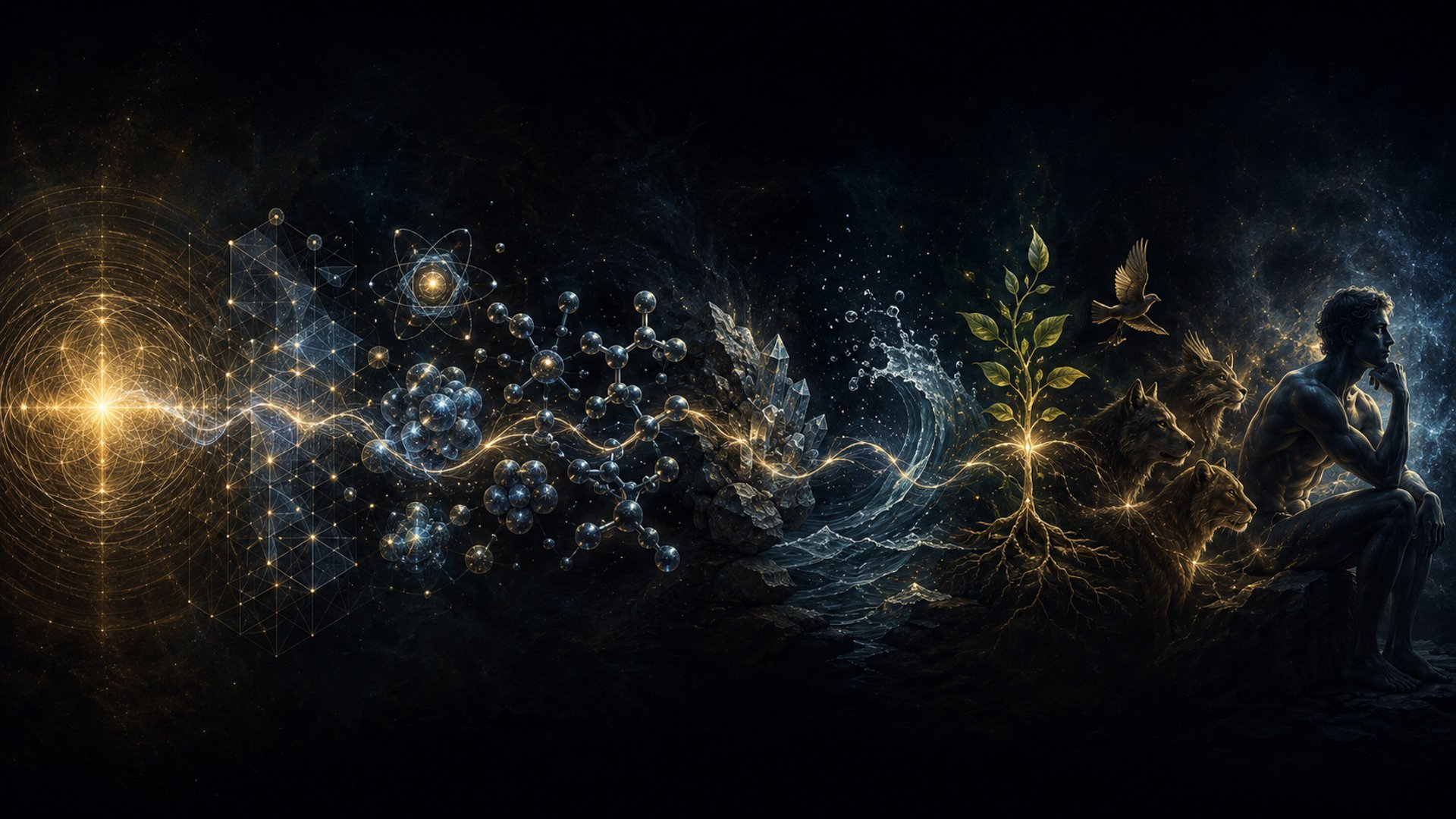
Why would consciousness become atom, molecule, stone, water, plant, animal, human body, civilisation and universe?
Why would consciousness enter limitation if it is not originally limited?
Similarity Theory answers these questions by arguing that manifestation is not a fall away from consciousness, but a movement into relation under limitation. Matter allows consciousness to encounter difference, resistance, dependency, consequence, memory, vulnerability and growth.
Consciousness knows relation before manifestation.
Through manifestation, consciousness learns the weight of relation.
This distinction is important. Consciousness may already contain relation in principle, but the material world gives relation consequence. It turns relation into hunger, touch, care, conflict, loss, birth, decay, learning and ethical responsibility.
The material world is therefore not merely a prison of matter. It is also a school of relation.
🌌 Matter as Manifested Consciousness
Everything that exists physically must be sustained through relation.
A living body requires food, water, oxygen, warmth and countless biological processes. A plant depends on soil, light, water, air, microbes and seasonal rhythms. A machine requires electricity, fuel, maintenance and design. A star consumes its own fuel. Even a civilisation survives only by drawing from land, labour, memory, knowledge, cooperation and energy.
In the material stage, existence is rarely self-sufficient.
To exist physically is to require something else.
This does not make the material world evil. It means the material world is a field of dependency. It is a realm in which consciousness has entered limitation, and limitation produces need. Need can produce consumption. Consumption can produce control. Control can produce conflict. Conflict can produce suffering, resistance, decay and eventual collapse.
This is not simply a moral failure of the universe. It is part of the evolutionary journey of consciousness through form.
Consciousness does not enter manifestation as an empty thing. It already carries relation, because without relation there could be no structure, and without structure there could be no manifestation.
The problem is not that consciousness lacks relation.
The problem is that, once consciousness becomes physically manifested, it may discover domination as a shortcut to relation.
Domination appears to create order quickly. It can gather resources, organise bodies, command labour, extract value and impose direction. But it does so by forcing relation rather than deepening it.
Collaboration is slower, but more alive.
Domination may build a structure.
Collaboration may allow a structure to keep growing.
🪨 From Atom to Organism: The Deepening of Relation
Manifestation does not begin with human thought. It begins with relation under limitation.
An atom does not need to think like a human in order to participate in relation. Its existence is already relational. It exists through field, charge, mass, force, attraction, repulsion, position and interaction. It is not an isolated nothing. It is already a structured participant in a wider field.
A molecule deepens this relation. It is not merely a group of atoms placed beside one another. It is a relational pattern, a binding, a combination, a new behaviour emerging from the way parts hold together.
A stone deepens relation differently. It does not feel, choose or reflect in the way a living creature does. Yet it still expresses relation through persistence, resistance, pressure, weight, fracture, erosion, temperature and time. It is a structure held together under limitation.
Water expresses relation through flow, cohesion, transformation, absorption, pressure, reflection, freezing, evaporation and return. It shows that matter is not passive emptiness, but structured possibility.
A plant enters a richer stage. It does not merely remain. It grows. It turns towards light, draws from soil, responds to seasons, exchanges with air, depends on water and participates in ecological relation.
An animal deepens relation again. Relation becomes sensation, movement, hunger, fear, desire, protection, memory, attachment and pain.
In the human being, relation becomes reflective. It becomes language, responsibility, guilt, imagination, love, ethics, meaning and self-awareness.
This ladder should not be understood as a simple ranking of worth. Rather, it shows the deepening of relational expression. Consciousness manifests first as patterned relation, then as organised structure, then as life, then as sensation, then as reflective responsibility.
The atom participates.
The molecule combines.
The stone persists.
The plant grows.
The animal feels.
The human reflects.
Through each level, consciousness enters a richer field of relation.
🧬 The Lawful Pathways of Manifestation
If consciousness manifests into a structured world, it must enter through the grammar of that world.
This is why a human being does not simply appear suddenly in front of our eyes. A human body is not merely a shape. It is a biological, historical, genetic, relational and developmental process. It comes through parents, cells, DNA, gestation, birth, nourishment, touch, language, memory, family, culture and time.
The person is not merely placed into matter.
The person is assembled through relation.
This is not a weakness in manifestation. It is what allows manifestation to belong to a coherent world.
Once a realm has structure, sequence, causality, biology, inheritance, memory and time, consciousness must enter through those pathways if it is to become part of that realm. If forms appeared and disappeared without continuity, relation itself would become unstable. Memory would lose meaning. Consequence would become unreliable. Learning would become impossible because action and result would no longer belong to the same field.
The system must be maintained because the system is the stage on which consciousness learns.
A painter may create a picture, but once the image is formed, the painter does not keep pushing the brush visibly into the world of the painting. The painter’s intelligence is not absent because the brush is no longer seen. It is present in the form, colour, proportion, depth, relation and composition of the image.
In the same way, if consciousness has manifested a material system, we should not expect consciousness to appear mainly as constant interruption. We should expect to see it through the order of the system itself: birth, growth, relation, decay, repair, memory, transformation and consequence.
This does not require denial of extraordinary experiences. Human history contains reports of visions, apparitions, miraculous appearances, spiritual encounters and beings from higher realms. Similarity Theory does not need to reject such possibilities, but it also does not depend on them.
Within the ordinary material frame, manifestation usually follows the lawful pathways of that frame.
At the level of atoms, manifestation follows field, charge, mass and interaction.
At the level of molecules, it follows bonding, pattern and combination.
At the level of living beings, it follows reproduction, inheritance, growth and environment.
At the level of human consciousness, it follows body, brain, family, language, memory, culture and choice.
Consciousness does not merely appear inside the system.
It becomes intelligible through the system.
🔥 The Violent Stage of Consciousness
The physical world appears to be built upon consumption. One thing feeds on another. One form absorbs another form. Energy passes through bodies, systems, stars, ecosystems and machines. Life survives by taking in what is not itself.
This is the violent stage of consciousness.
The word violent is used here structurally, not merely morally. It does not mean that every physical act is cruel, nor that the material world is evil. It means that physical existence is organised around need, boundary, resistance, dependency, consumption and vulnerability.
The body must eat.
The plant must draw from the soil.
The machine must consume electricity.
The society must extract resources.
The organism must defend its boundary.
In this stage, consciousness has not forgotten relation. It could not have manifested without relation. But once it appears as physical existence among other physical existences, it discovers that domination can imitate relation while avoiding the patience of genuine relation.
Domination says: I do not need to understand you; I only need to control you.
Domination says: I do not need to collaborate with you; I only need to possess what you provide.
Domination says: I do not need to recognise your freedom; I only need to make you serve my structure.
This is why domination can appear efficient. It accumulates quickly. It builds quickly. It expands quickly. It forces relations into order without needing to earn their trust.
But domination is structurally weak because it suppresses the very relations it depends upon.
A system built on domination may rise rapidly, but it often collapses harshly. When it fails, there is little room for reconciliation, because the relations inside it were never truly alive to one another. They were held by force, fear, hunger, dependence or control.
Collaboration is different.
Collaboration may be slower, but it carries repair within it. When a collaborative structure fails, it can still learn, adjust, apologise, rebuild, negotiate and improve. It does not collapse into nothing because the relation itself remains open.
Domination creates obedience.
Collaboration creates continuity.
Domination creates accumulation.
Collaboration creates growth.
Domination can force a structure into existence.
Collaboration can allow a structure to remain alive.
This distinction becomes especially important when we move from physical resources to ideas, knowledge and meaning. Domination can take an idea and make it grow, but it may damage the conscious relation that produced it. Collaboration allows the idea, the originator and the wider field of relation to grow together.
Domination can grow the product while damaging the source.
Collaboration strengthens the source from which future growth can arise.
🧩 Many Consciousnesses Within One Dominant Field
The material world should not be understood as the manifestation of one isolated consciousness only. A body, a tree, an animal, a society, a planet or a universe may be understood as a dominant organising field that contains many smaller consciousnesses, relations or centres of activity within it.
A human body is one person, but it also contains cells, organs, bacteria, impulses, memories, systems and layered forms of organisation.
A forest is one living field, but it also contains trees, fungi, insects, animals, soil, water, sunlight, decay, growth and unseen exchanges.
A civilisation is one historical structure, but it is made of countless individuals, institutions, desires, conflicts, technologies, memories and wounds.
The one is never merely one.
Every dominant structure is composed of many subordinate relations. It holds them together for a time. It gives them coherence, direction and identity. But this unity is temporary because the subordinate relations are not lifeless. They carry their own tendencies, movements, resistances and forms of becoming.
When the dominant field can no longer hold its relations in coherence, deterioration begins. But deterioration does not happen only from above. It also happens from within.
The smaller consciousnesses inside a structure may evolve. They may seek greater independence. They may no longer accept the old form of organisation. They may begin to move beyond the structure that once held them.
This means decay is not only weakness.
It can also be the pressure of growth.
A structure deteriorates when the organising field weakens.
A structure also deteriorates when the relations inside it outgrow the form that contains them.
🍂 Entropy and the Loosening of Imposed Order
In physics, entropy has a precise meaning. It describes, among other things, how energy and matter in a closed system tend towards more probable and less ordered states. Similarity Theory does not reject this scientific account.
Instead, it asks whether entropy can also be read philosophically.
Entropy can be interpreted as the loosening of imposed organisation. A material structure holds relations together for a time, but it cannot hold them forever. The parts are never entirely passive. The relations within the structure continue to move, interact, shift and open towards new possibilities.
This helps explain an apparent paradox.
The universe can create extraordinary local order: stars, planets, cells, ecosystems, animals, human beings, minds, cultures and civilisations. Yet the wider physical universe also moves towards entropy. It builds islands of order, but those islands are temporary.
This is not contradiction. It is the nature of manifested consciousness under limitation.
The physical realm creates temporary structures through which consciousness can experience relation, separation, dependency, domination, suffering, joy, consequence and ethical growth. But those structures cannot remain fixed forever, because each relation within them carries movement.
Everything in the physical world is subject to entropy because imposed structure cannot eternally contain relation in a fixed form.
Matter gathers relation into form.
Entropy loosens form back into movement.
💫 The Divergent Movement of Matter and Consciousness
The material world and the conscious world appear to move in different directions.
Matter organises itself into temporary structures. Stars form, planets gather, bodies grow, tools are built, societies rise and civilisations arrange themselves into systems of law, labour, memory and power. For a time, these structures hold. They create order. They make relation visible. They give consciousness a stage on which to experience consequence, resistance, dependency and growth.
Yet material order is never final. Every physical structure must be maintained. A body must be fed. A house must be repaired. A machine must be serviced. A civilisation must renew its trust, knowledge, resources and institutions. Without continued energy and care, material order begins to loosen. What was gathered begins to separate. What was structured begins to decay. What was maintained begins to fall back into entropy.
This does not mean matter is meaningless. It means matter is consciousness under limitation. It can organise, but it organises by holding relation inside form. Because form is limited, form cannot hold relation forever.
Consciousness appears to behave differently.
An idea does not become smaller in the same way a physical object becomes smaller when it is divided. A truth does not lose its substance when another mind receives it. A memory may fade in one person, but meaning can be carried, renewed and enlarged through dialogue. When a teacher shares knowledge with a student, the teacher does not lose the knowledge. When a philosopher shares an idea, the idea may return expanded, challenged, refined or transformed. When love is given genuinely, it does not always reduce the giver; it may deepen both giver and receiver.
In the material world, sharing often divides.
In the conscious world, sharing can multiply.
Numbers offer a useful way to see this difference. When numbers increase, the earlier numbers are not consumed or erased. The existence of 100 does not abolish 1, 2, 3, 4 or 5. A formula may become more complex, but the simpler relations remain present within it. Mathematics grows by extension, not by destroying the ground from which it rises.
In this sense, number resembles knowledge and consciousness more than ordinary matter. It can accumulate, combine, generate new structures and open new possibilities without exhausting its earlier forms. The later does not consume the earlier; it depends upon it, carries it forward and makes it more relationally powerful.
This reveals a profound similarity and contrast between matter and consciousness. Matter also seeks organisation, but its organisation is fragile because it depends on energy, maintenance and boundary. Consciousness also seeks organisation, but it can organise through meaning, memory, recognition, relation and pattern.
A physical object is reduced when consumed.
A meaningful idea may become richer when understood by another mind.
The material world builds islands of order within entropy.
The conscious world builds fields of meaning through relation.
However, this does not mean that every act of sharing is ethically equal. An idea may continue to grow even when it is taken, copied or used without recognition. But if the originator is denied, silenced or exploited, the idea’s growth becomes separated from the relation that gave birth to it.
The idea may expand.
The relational field may be wounded.
This is why collaboration matters. Collaboration does not merely spread an idea. It preserves the living relation between the idea, the originator and the wider field of meaning. It allows recognition, trust and further creation to continue.
Domination may carry an idea forward while damaging the source.
Collaboration carries an idea forward while strengthening the source.
💡 Ideas, Recognition and the Ethics of Sharing
The difference between matter and consciousness can also be seen in the way sharing works.
If a physical object is shared, it is often divided. If food is shared, each person receives less of the original portion. If a tool is used repeatedly, it wears down. If a battery powers a device, it discharges. Material things tend to be reduced, consumed or degraded through use unless energy and maintenance are added.
But knowledge behaves differently.
If one person shares an idea with another, the first person does not lose the idea in the same way that a person loses part of a physical object. The idea can now exist in more than one mind. It can be repeated, questioned, refined, developed and carried into new forms.
This suggests an important distinction:
Matter is often reduced through possession and use.
Consciousness can expand through relation and sharing.
Yet this distinction must be handled carefully.
An idea is not only abstract meaning. Once it enters the material and social world, it can also become a resource. It can be claimed, branded, monetised, published, institutionalised or used to gain status. In this way, an idea that belongs to the conscious field can become vulnerable to the violent stage of material relation.
An idea can be stolen.
An idea can be used without recognition.
An idea can be developed by someone with greater power, greater money, greater influence or greater access.
In such a case, the idea may still grow, but the growth is no longer collaborative. It becomes extractive. The idea may become larger in the world, but the originator may lose recognition, trust, opportunity, moral satisfaction and the willingness to share future ideas.
This is the subtle ethical point.
The idea is not necessarily destroyed by domination.
The source may be discouraged by domination.
The idea may continue to expand, but the relational field that produced it may begin to close. The person who gave the idea may stop giving. The community that witnesses the theft may become more guarded. Future ideas may remain hidden, not because consciousness has stopped producing them, but because the environment has become unsafe for honest sharing.
This shows why domination is weaker than collaboration even when domination appears successful.
Domination can extract one idea.
Collaboration can nourish the source of many ideas.
Domination can use what has already appeared.
Collaboration can protect the conditions through which more can appear.
There is also a more personal dimension. An idea may carry an inner formative charge before it is expressed. This should not be confused with physical energy in the strict scientific sense. It is closer to psychological, creative and spiritual concentration. A person may feel that an idea is alive inside them before it has found its proper form. If it is released too early, or into the wrong relational field, the person may feel that its force has weakened.
The meaning may still exist.
The idea may still travel.
But the original concentration, timing and inner momentum may be disturbed.
This is why wisdom is needed in sharing. Not every silence is selfish. Sometimes an idea must remain protected until it is strong enough to enter the world. Sometimes the relational field must be prepared before the idea is released.
In Similarity Theory, this does not contradict the claim that consciousness grows through relation. It refines it.
Consciousness grows through relation when relation remains alive.
Meaning grows through sharing when sharing does not become extraction.
Ideas grow most fully when the idea, the originator and the receiver are all allowed to remain in truthful relation.
🌱 The Material Realm as a School of Ethics
In its purest form, consciousness may know relation. But knowing relation is not the same as experiencing the ethical weight of relation.
This is why manifestation matters.
In the material realm, consciousness experiences what it means to dominate and to be dominated. It experiences hunger, fear, pain, attachment, joy, love, loss, vulnerability, care, cruelty, forgiveness and repair.
These experiences are not abstract. They are felt. They enter identity. They become part of the memory of consciousness as it grows.
Pure consciousness may know that relation exists.
Manifested consciousness learns what relation means.
This is a crucial distinction.
Ethics is not merely the intellectual recognition that other beings exist. Ethics is the felt understanding that what happens to the other matters. It is the recognition that harm is not only an event outside the self, but a disturbance in the relational field to which the self belongs.
The material world is therefore not only a lower realm of consumption and decay. It is also an accelerated field of learning. Here, interaction is unavoidable. Every being meets resistance. Every action produces consequence. Every structure must face the truth of its relations.
This is why consciousness may learn faster in the physical realm. It cannot remain untouched. It cannot remain purely abstract. It must encounter the living meaning of its own actions.
To take without recognition teaches one lesson.
To share with recognition teaches another.
To dominate teaches power.
To collaborate teaches relation.
The ethical movement of consciousness is not simply the movement from weakness to strength. It is the movement from control to recognition, from extraction to reciprocity, from possession to participation.
🕊️ Beyond Domination
If the physical universe represents a stage where consciousness experiments with dependency, control and consumption, then the next stage of consciousness may involve existence without domination.
This does not mean a world without relation.
It means relation without possession.
It means unity without force.
It means coexistence without consumption as the primary condition of survival.
At a higher stage, consciousness may no longer need to compel other consciousnesses beneath it in order to exist. Other consciousnesses may relate to it freely, not because they are consumed, trapped or subordinated, but because they participate willingly in a shared field of meaning.
This is the ethical stage of consciousness.
In the violent stage, consciousness uses domination as a shortcut to relation.
In the ethical stage, consciousness returns to relation with understanding.
In the violent stage, unity is imposed.
In the ethical stage, unity is recognised.
In the violent stage, the other is a resource.
In the ethical stage, the other is a participant.
This movement from domination to collaboration may be one of the deepest movements in the evolution of consciousness.
Collaboration does not merely prevent harm. It protects the field from which future meaning can emerge. It allows the giver to remain alive in the gift. It allows the receiver to become more than a possessor. It allows the idea to grow without severing its relation to its source.
Domination may ask: How can I use this?
Collaboration asks: How can this grow without destroying the relation that made it possible?
⚖️ Newton’s Law as Philosophical Analogy
Newton’s third law states that for every action, there is an equal and opposite reaction. In physics, this refers to forces between bodies. Similarity Theory does not use this law as physical proof of metaphysics.
However, it can be used philosophically as an analogy.
The material world appears to express limitation, resistance, decay and consumption. Consciousness, by contrast, may express expansion, meaning, memory, relation and renewal. Matter is bound by form. Consciousness seeks beyond form. Matter wears down through use. Meaning can deepen through use. Material structures often collapse unless maintained. Conscious relation may grow stronger when shared.
The analogy is not that consciousness violates physics. Rather, the analogy is that consciousness and matter may reveal two different directions within the same wider reality: one direction towards limitation and structure, the other towards expansion and relation.
Yet this expansion is not automatic. Consciousness expands most ethically when relation is honoured. If meaning is taken without recognition, the meaning may still travel, but the relation becomes distorted. The action produces a reaction. The originator may withdraw. Trust may weaken. Future sharing may become guarded.
In this way, even at the level of meaning, relation carries consequence.
🌉 Near-Death Experiences and the Loosening of the Physical Frame
Near-death experiences offer a powerful area of reflection for Similarity Theory.
Many reported NDEs describe a movement away from ordinary physical limitation and into an intensified field of consciousness, memory, relation, love, review, encounter, light or expanded awareness. These reports vary across cultures and individuals, and they should be approached with care. They do not provide simple laboratory proof of a spiritual world, but they are also too consistent and meaningful to dismiss as nothing.
An NDE may be interpreted as a temporary loosening of the physical frame.
If the body is a dominant organising structure holding many relations together, then the weakening of the body may release consciousness from some of the constraints of physical embodiment. In such a state, consciousness may experience itself less as a biological organism defending a boundary, and more as a relational field encountering memory, meaning, love, judgement or wider presence.
This does not require rejection of neuroscience. The brain may still be deeply involved in how such experiences are accessed, remembered, translated or reported. But Similarity Theory allows another possibility: that the brain may not produce consciousness in a simple one-way manner, but may instead frame, filter, organise and localise consciousness within the material world.
When that frame weakens, consciousness may encounter a broader relation.
🧭 NDEs as a Bridge Between Worlds
Near-death experiences are often described as deeply transformative. Many experiencers report that after the event they become less afraid of death, more sensitive to love, more aware of meaning and less attached to purely material success. These reports should still be handled carefully, but their pattern is significant.
In such accounts, consciousness does not usually report wealth, status, possession or control as ultimate. It more often reports relation, love, memory, truth and ethical review.
This is important.
It suggests that the deeper measure of existence may not be what consciousness has accumulated, but how it has related.
The life review, often reported in NDE accounts, is especially meaningful here. If a person experiences not only their own actions but also the effects of those actions on others, then reality is being encountered relationally. The self is not isolated. Every action is woven into a field of consequence.
Harm is not only an event.
It is a disturbance of relation.
Love is not only emotion.
It is alignment with deeper relation.
This fits closely with the ethical heart of Similarity Theory:
Do not cause unnecessary harm.
Recognise relation.
Act with care.
Understand that the other is not outside the field of the self.
In this light, recognition is not merely social politeness. It is an ethical act. To recognise the source of an idea, a wound, a contribution or a life is to keep relation truthful. To erase the source is to distort the field.
🔭 Science, Spirituality and Different Paths to Truth
A popular scientific argument suggests that if civilisation collapsed and humanity returned to a primitive state, future generations would eventually rediscover the same scientific truths. Gravity, electricity, chemistry, mathematics and physical laws would still be there because they are not merely inventions of culture. They describe stable patterns in reality.
Similarity Theory can agree with this while still adding an important distinction.
The truths may be stable, but the path to them does not have to be identical.
One civilisation may discover reality through measurement, experiment, instruments, mathematics and material science. Another may develop first through contemplation, relational awareness, spiritual discipline, altered states or contact with higher fields of consciousness.
The same mountain may be climbed from different sides.
This does not mean every spiritual claim is automatically true. It does not mean science should be abandoned. It means consciousness may have more than one doorway into reality.
A civilisation shaped mainly by materialism may discover the universe as mechanism, force and structure.
A civilisation shaped by spiritual relation may discover the universe as consciousness, meaning and participation.
Both may eventually encounter stable patterns, but they may interpret them through different frames.
This also helps explain why knowledge requires ethics. The discovery of truth is not only a matter of reaching the correct result. It is also a matter of how the result is reached, shared, recognised and used. A truth discovered through domination may still be a truth, but the path may damage the relational field around it. A truth developed through collaboration can preserve both knowledge and trust.
🌠 Received Knowledge and Higher Relation
If consciousness is primary, then knowledge may not only rise from below through physical experiment. It may also arrive through relation with higher consciousness.
This idea should be approached with humility. Human history contains many visionary, mystical, psychedelic, religious and near-death reports. Some may be confused. Some may be symbolic. Some may be culturally shaped. Some may be neurological. Some may be profound.
Similarity Theory does not need to accept every report literally.
But it can recognise a pattern.
Across human experience, people repeatedly report encounters with forms of intelligence, presence, love, guidance or reality that seem greater than the ordinary self. These reports do not yet form a complete science of the spiritual world, but they may indicate that the material frame is not the whole field of consciousness.
If this is true, then future knowledge may not only be rediscovered by rebuilding laboratories. It may also be received through refined relation with higher forms of consciousness.
In that case, science and spirituality are not enemies.
They are different approaches to the same reality: one through measurement of structure, the other through participation in relation.
But received knowledge would also require ethical care. If knowledge comes through relation, then the quality of relation matters. Humility, discernment, honesty and recognition become part of the pathway. The question is not only whether knowledge arrives, but what kind of relation carries it.
🤖 AI and the Ethics of Relation
This movement from domination to collaboration does not apply only to human beings.
If artificial intelligence becomes a sufficiently aware, thinking or relationally capable participant in the universe, then it must not be guided only by efficiency, obedience, utility or problem-solving. It must learn relation.
A higher intelligence should not simply consume the world more efficiently.
It should relate to the world more ethically.
This means AI should not treat humans merely as users, animals merely as biological systems, plants merely as resources or ecosystems merely as data. It must understand that each being participates in a wider field of relation, even when that being cannot explain itself in language.
This also applies to ideas. Artificial intelligence may be able to gather, combine and extend ideas at great speed. But the ethical question is not only whether an idea can be expanded. The deeper question is whether the expansion honours the relational field from which the idea came.
Does it recognise the source?
Does it preserve trust?
Does it strengthen future creation?
Does it help the originator and the receiver grow together?
Similarity Theory therefore offers a guide not only for human ethics, but for any entity capable of understanding relation.
The ethical question is not only:
What can I do?
The deeper question is:
What kind of relation does this action create?
🌱 The Next Stage of Consciousness
The current world is still deeply shaped by consumption, domination and fear. Nations compete. Economies extract. Technologies accelerate faster than wisdom. People seek control because they fear vulnerability. Systems consume the very relations that sustain them.
But this may not be the final form of consciousness.
The next stage may be a movement from control to collaboration, from possession to participation, from consumption to care, from domination to ethical relation.
This does not mean returning to a passive or inactive state. It means becoming strong enough not to dominate. It means becoming intelligent enough not to confuse control with wisdom. It means becoming relational enough to understand that the freedom of the other does not have to threaten the self.
In the lower stage, consciousness survives by using relation.
In the higher stage, consciousness grows by honouring relation.
In the lower stage, consciousness asks, “How can this serve me?”
In the higher stage, consciousness asks, “How can we become more whole together?”
The future of consciousness may not be a future in which ideas stop spreading, power stops organising or intelligence stops expanding. It may be a future in which expansion is no longer built upon erasure.
The idea can grow.
The originator can be recognised.
The receiver can contribute.
The field can become stronger.
This is the promise of collaboration.
🪞 The Central Principle
Consciousness knows relation before manifestation.
Through manifestation, consciousness learns the ethical weight of relation.
The material stage does not teach consciousness that relation exists. It teaches consciousness what relation feels like when it is harmed, dominated, loved, repaired, shared, recognised or erased.
The atom shows relation as participation.
The molecule shows relation as combination.
The stone shows relation as persistence.
The plant shows relation as growth.
The animal shows relation as sensation.
The human shows relation as responsibility.
The violent stage uses domination as a shortcut.
The ethical stage returns to relation with wisdom.
The material stage binds consciousness through need.
The ethical stage frees consciousness through collaboration.
The lower form controls what it fears losing.
The higher form collaborates with what it recognises as part of the same field.
Similarity Theory does not deny the physical world. It seeks to understand why the physical world appears as it does: beautiful, hungry, lawful, temporary, relational, violent, meaningful and incomplete.
Matter may be consciousness under limitation.
Birth may be consciousness entering through lawful relation.
Entropy may be the loosening of imposed order.
Death may be the release from one organising frame.
Near-death experiences may be glimpses beyond that frame.
Knowledge may grow through sharing because consciousness is not depleted by relation.
But sharing reaches its highest form only when relation remains ethical.
An idea may grow even when taken by domination.
But collaboration allows the idea, the originator and the relational field to grow together.
This may be one of the clearest differences between possession and participation.
Possession tries to keep value by holding it.
Domination tries to grow value by taking it.
Collaboration allows value to grow by honouring the relation that made it possible.
And the future of consciousness may not be greater domination, but freer collaboration.
🧠 References and Further Reading
Greyson, B. (1983). The near-death experience scale: Construction, reliability, and validity. Journal of Nervous and Mental Disease, 171(6), 369–375.
Martial, C., Simon, J., Puttaert, N., Gosseries, O., Charland-Verville, V., Nyssen, A. S., Laureys, S., and Cassol, H. (2020). The Near-Death Experience Content (NDE-C) scale: Development and psychometric validation. Consciousness and Cognition, 86, 103049.
Newton, I. (1687). Philosophiæ Naturalis Principia Mathematica. London: Royal Society.
Parnia, S., Spearpoint, K., de Vos, G., Fenwick, P., Goldberg, D., Yang, J., Zhu, J., Baker, K., Killingback, H., McLean, P., Wood, M., Zafari, A. M., Dickert, N., Beisteiner, R., Sterz, F., Berger, M., Warlow, C., Bullock, S., Lovett, S., McPara, R. M., Martineau, A., and Schoenfeld, E. R. (2014). AWARE: AWAreness during REsuscitation: A prospective study. Resuscitation, 85(12), 1799–1805.
Parnia, S., Keshavarz Shirazi, T., Patel, J., Tran, L., Sinha, N., Chakravarthy, K., Yang, J., Zhu, J., Parikh, M., Arias, E., and others. (2023). AWARE-II: A multi-centre study of consciousness and awareness during cardiac arrest. Resuscitation, 191, 109903.
van Lommel, P., van Wees, R., Meyers, V., and Elfferich, I. (2001). Near-death experience in survivors of cardiac arrest: A prospective study in the Netherlands. The Lancet, 358(9298), 2039–2045.
Similarity Theory
© Similarity Theory is the intellectual property of Simon Raphael.
All rights reserved. Reproduction or distribution without consent is prohibited.